
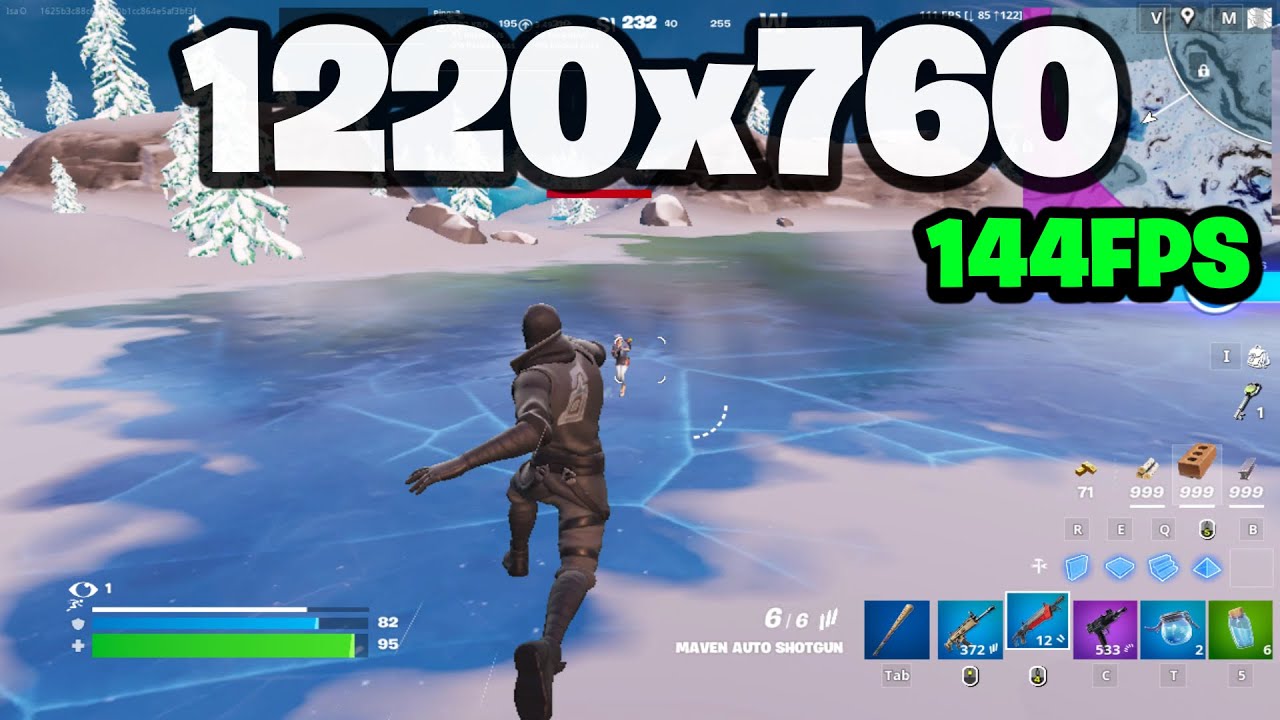
Last updated: May 2026. Tested across NVIDIA Game Ready 555.99, AMD Adrenalin 25.4, AlphaRes v1.1.0, and Fortnite Chapter 7 Season 2 on Windows 11 24H2.
Stretched resolution remains one of the most common competitive Fortnite tweaks in Chapter 7. The format renders the game at a non-native horizontal pixel count and lets the GPU scale the output to a 16:9 panel, producing wider character models, lower render cost, and a measurable FPS uplift on most hardware tiers. The catch is that “setting” a stretched resolution is not a single procedure. There are four mainstream methods, each with different persistence behavior, GPU compatibility, and risk profile. Picking the wrong one for a given setup is why most players who try stretched resolution once give up after the next Fortnite patch silently resets it. This guide was originally published in April 2024 and has been comprehensively rewritten and re-tested for 2026 to reflect Chapter 7 renderer changes, the AlphaRes v1.1.0 toolchain, and current NVIDIA / AMD driver behavior.
The four methods covered below are the NVIDIA Control Panel custom resolution, the AMD Adrenalin custom resolution, a manual GameUserSettings.ini edit, and the AlphaRes utility. Each one ends in the same place (Fortnite running at, for example, 1600×1080 stretched on a 1920×1080 panel), but the path differs and so does the staying power. The recommendation up front: AlphaRes is the only method that locks the resolution against Fortnite’s patch pipeline without manual file-system babysitting. The rest of the guide explains why that matters and walks through every alternative for players who want to make the call themselves.
TL;DR The Four Methods at a Glance
- Four mainstream methods exist for setting a Fortnite stretched resolution in 2026: the NVIDIA Control Panel custom resolution, the AMD Adrenalin custom resolution, a manual
GameUserSettings.iniedit, and the AlphaRes utility. - All four reach the same end state, but each has different trade-offs on persistence (does the change survive a Fortnite patch), GPU compatibility (NVIDIA-only versus AMD-only versus universal), and risk (easy to revert versus easy to break).
- Only AlphaRes locks the resolution against Fortnite patches automatically, by writing the values and flipping the read-only attribute on
GameUserSettings.iniin a single click. The manual INI edit can replicate the lock if a player knows to set the read-only flag in Windows Explorer afterward. - NVIDIA Control Panel and AMD Adrenalin custom resolutions work at the driver level and do not survive a Fortnite patch on their own, because the game rewrites its own resolution preference inside
GameUserSettings.inion every update. - The recommendation is AlphaRes for set-and-forget, the manual INI edit for power users who want full audit control, NVCP for NVIDIA players who do not mind reapplying after each patch, and Adrenalin for AMD players in the same boat. This guide compares all four side by side so the choice is informed.
What Stretched Resolution Is and Why Fortnite Players Use It
Stretched resolution in Fortnite means rendering the game at a horizontal pixel count smaller than the monitor’s native value, then letting the GPU scale that smaller frame across the full panel. A 1920×1080 monitor running Fortnite at 1600×1080 is the canonical example: the game internally renders 1600 horizontal pixels and the GPU stretches that frame across all 1920 columns of the panel. The result is a wider, fatter image where character models appear horizontally enlarged. A complete plain-English breakdown lives in What Is Stretched Resolution in Fortnite; the short version is below.
Three measurable advantages drive adoption. First, enemy character models render visibly wider, which makes them slightly easier to track and hit at mid range. Second, the smaller render target means the GPU works less per frame, raising average FPS by anywhere from 6 to 30 percent depending on the resolution chosen and the GPU class. Third, the input-to-photon path shortens fractionally because the rendered frame is smaller. Pro players have used stretched resolutions in Fortnite since the format gained traction during Chapter 2, and the practice continues to dominate competitive setups in Chapter 7. The trade-off is a narrower effective horizontal field of view, because Fortnite Chapter 7 derives FOV from horizontal resolution and does not expose a manual slider.
The Four Methods at a Glance
Before walking through each procedure, the comparison below summarizes how the four methods stack up. The columns track the dimensions that matter for Fortnite specifically: whether the change persists across patches, whether the method is tied to a specific GPU vendor, how easy the procedure is, and how much can go wrong.
| Method | Lock persistence | GPU compatibility | Skill level | Risk | Verdict |
|---|---|---|---|---|---|
| NVIDIA Control Panel | None (resets after patch) | NVIDIA only | Easy | Low | Partial: needs reapply |
| AMD Adrenalin | None (resets after patch) | AMD only | Easy | Low | Partial: needs reapply |
| Manual INI edit | Manual (read-only flag) | Any GPU | Intermediate | Low if careful | Fragile but flexible |
| AlphaRes (recommended) | Automatic | Any GPU | Easy | None | Recommended |
GameUserSettings.ini on every patch and on most major launches, resetting the resolution back to native unless the file is read-only. The four methods differ less in how they apply the resolution and more in whether the resolution survives the next update. That single column is the most important one in the table.
Method 1: NVIDIA Control Panel
The NVIDIA Control Panel exposes a custom-resolution feature that adds a non-native option to Windows and to in-game resolution dropdowns. The procedure is the same on Windows 10 and Windows 11, with NVIDIA Game Ready driver 555.99 or newer. This method works exclusively on NVIDIA discrete GPUs (GTX 10-series and newer) and requires that GPU Scaling be set to perform on the GPU rather than the display. A direct comparison with AlphaRes lives in AlphaRes vs NVIDIA Control Panel.
Open NVCP
Right-click the Windows desktop and choose NVIDIA Control Panel. If it is not in the context menu, search for it from the Start menu.
Display tab
In the left tree, expand Display and click Change resolution. Confirm the correct monitor is selected at the top.
Customize
Click Customize, tick Enable resolutions not exposed by the display, then Create Custom Resolution. Enter horizontal pixels (for example 1600), vertical pixels (1080), and the refresh rate of the panel.
Test and apply
Click Test to validate. If the panel accepts, save and select the new resolution in Windows display settings, then in Fortnite’s video settings.
Once applied, Fortnite will see the new resolution in its in-game video dropdown. The catch arrives at the next Fortnite patch. The launcher rewrites GameUserSettings.ini with default values, and the in-game resolution preference reverts to native. The custom resolution still exists at the driver level, but Fortnite no longer points at it. Reapplying means going back into Fortnite’s video settings and re-selecting it. Players who patch infrequently can live with this. Players on weekly patch cycles will burn five minutes per week on the manual reset and eventually switch methods. The driver-level approach is also vulnerable to NVIDIA driver reinstalls, which clear all custom resolutions; a clean install of a Game Ready driver wipes them and requires recreating the entries.
Method 2: AMD Adrenalin
AMD Adrenalin (Radeon Software 25.4 or newer in 2026) provides equivalent functionality for AMD discrete GPUs and APUs. The path differs from NVCP in two important ways: AMD requires GPU Scaling and Full Panel mode to be enabled in the same dialog before a custom resolution will display correctly, and the timing parameters are exposed by default rather than hidden. The full method comparison versus AlphaRes lives in AlphaRes vs AMD Adrenalin.
Open Adrenalin
Right-click the desktop and choose AMD Software: Adrenalin Edition, or launch from the system tray icon.
Display section
Click the Display tab. Enable GPU Scaling and set the Scaling Mode to Full Panel so the stretched output fills the screen rather than letterboxing.
Custom Resolutions
Scroll to Custom Resolutions and click Create New. Enter horizontal (1600), vertical (1080), the panel’s refresh rate, and standard CVT-RB timing.
Save and apply
Save the custom mode. Switch Windows to it via Display Settings, then choose it inside Fortnite’s video options.
The patch-reset weakness applies identically to the Adrenalin path. The custom resolution lives at the driver level inside Adrenalin’s profile database, but Fortnite’s in-game preference still resets each patch. AMD’s driver also has a known behavior where reinstalling Adrenalin (which the Auto-Detect installer does whenever a major driver branch ships) clears the custom resolution list. AMD users on weekly patches typically end up reapplying both inside Adrenalin and inside Fortnite, which is roughly twice the maintenance burden of the NVIDIA path. Full Panel mode also has to be re-enabled after some driver updates, because Adrenalin defaults that setting to Preserve Aspect Ratio on a fresh install, which produces black bars instead of a stretched output.
Method 3: Manual GameUserSettings.ini Edit
The manual edit is the GPU-agnostic method. It works on any GPU because it modifies Fortnite’s own configuration file rather than going through a driver layer. The trade-off is precision: a single typo in the wrong key produces a black screen at launch or, worse, a corrupted profile that resets to native and stays there. The full AlphaRes-versus-manual comparison lives in AlphaRes vs Manual INI Edit.
Close Fortnite
Quit Fortnite and exit the Epic Games Launcher. The launcher must not be running, because it caches the settings file and will overwrite manual changes on close.
Navigate
Open File Explorer and paste %LOCALAPPDATA%\FortniteGame\Saved\Config\WindowsClient\ into the address bar. Locate GameUserSettings.ini.
Edit four keys
Open the file in Notepad. Find ResolutionSizeX, ResolutionSizeY, LastUserConfirmedResolutionSizeX, and LastUserConfirmedResolutionSizeY. Set the X pair to 1600 and the Y pair to 1080. All four must match.
Save
Save the file as plain text. Confirm it remains .ini and not .ini.txt. Notepad with default settings handles this correctly.
Read-only flag
Right-click GameUserSettings.ini, choose Properties, tick Read-only, and click OK. This blocks Fortnite from rewriting it on the next patch and is the step most manual editors forget.
The manual edit is the most flexible method because it allows arbitrary pixel values and arbitrary refresh-rate logic that the driver UIs sometimes refuse. It also works equally on NVIDIA, AMD, and Intel GPUs because nothing about the procedure touches the driver. The catch is that the read-only flag is the only thing standing between the player and a patch-reset, and it has to be set manually after every full reinstall of Fortnite (a fresh install creates a new GameUserSettings.ini without the flag). Players who edit the file but skip step 5 are essentially using the same fragile setup as the driver-level methods, just from a different angle. The procedure for permanently locking the file is documented in How to Lock Fortnite Resolution.
Method 4: AlphaRes (Recommended)
AlphaRes is a small Windows utility (v1.1.0 in 2026) that automates the manual INI edit and the read-only flag in a single click. It works on any GPU, requires no driver-level configuration, and produces a setup that survives Fortnite patches without manual reapplication. The application takes a width and height value, writes them to GameUserSettings.ini, optionally flips the read-only attribute, and exits. The full walkthrough lives in How to Apply a Stretched Resolution Using AlphaRes.
Download
Get AlphaRes v1.1.0 from the official download page. The installer is signed and Defender-clean.
Enter resolution
Launch AlphaRes after closing Fortnite. Type the desired width (for example 1600) and height (1080) into the fields.
Tick Read-only
Tick the Set as read-only checkbox. This is the step that locks the resolution against Fortnite’s patch pipeline. It is on by default in v1.1.0.
Apply
Click Apply. AlphaRes writes the values, sets the read-only attribute, and confirms with a status message. Launch Fortnite as normal.
Two specific behaviors set AlphaRes apart from the manual edit. First, the read-only checkbox is opt-in but enabled by default, which catches the most common mistake (forgetting to flip the flag). Second, the application updates all four resolution keys (ResolutionSizeX, ResolutionSizeY, LastUserConfirmedResolutionSizeX, LastUserConfirmedResolutionSizeY) atomically, which prevents the half-applied state where Fortnite reverts to the “last confirmed” value on next launch because only two of the four keys were changed. The result is a setup that survives Fortnite patches, Epic Games Launcher updates, and Windows feature updates without intervention. Players who run multiple PCs (a desktop tower and a tournament laptop, for example) typically just install AlphaRes on each and apply the same value, rather than maintaining driver-level custom resolutions in two places.
Decision Matrix: Which Method Fits Which Player
The four methods are not interchangeable. Each fits a specific player profile based on hardware, patching tolerance, and how much manual control the user wants over the configuration file. The matrix below maps the four most common profiles to the recommended method.
NVIDIA player, comfortable reapplying
Players who run NVIDIA hardware exclusively and do not mind a five-minute reset every Fortnite patch can stick with NVCP. The method exposes display-timing parameters that other paths hide, which is useful for unusual panels (ultrawide-1080p hybrids, esports panels with non-standard timing).
- Driver-level integration is reliable when the driver is fresh.
- The “make Fortnite use the new resolution” step still requires going into game settings each patch.
- Custom resolutions vanish on driver clean-installs and need recreating.
AMD player, system-wide custom timing
Players on Radeon hardware who also want the custom resolution to apply in other DX11 games or on the Windows desktop benefit from Adrenalin. The driver path applies system-wide rather than per-application.
- One configuration covers Fortnite plus other titles.
- Full Panel mode must stay enabled, or output letterboxes.
- The Fortnite-side reset still happens on every patch.
Power user, scripting and audit control
Players who script their own setup, version-control their Fortnite configs, or want to know exactly which bytes are changing in GameUserSettings.ini should edit it directly. The procedure is fully transparent, and the read-only flag handles persistence.
- Full visibility into what changed and why.
- Compatible with PowerShell scripts and dotfile syncing.
- Requires remembering the read-only step manually.
Competitive player, set-and-forget
Players whose priority is consistent in-game settings across patches without administrative work should use AlphaRes. The application solves the patch-reset problem in one click, on any GPU, without driver-level entanglement.
- One install covers any future patch.
- GPU-agnostic, works on a tournament loaner laptop with Intel iGPU.
- Read-only checkbox eliminates the most common mistake.
The Patch Problem (The Headline Difference)
Every method discussion above keeps coming back to the same point: Fortnite rewrites GameUserSettings.ini on every patch and on most launcher updates. The exact mechanism is that the Epic Games Launcher’s update step calls into Fortnite’s settings module, which validates the on-disk INI against a default template and rewrites any keys it considers invalid. The “valid” set of resolutions in 2026 is a hardcoded list that includes native 1920×1080 and the Fortnite preset values, but does not include arbitrary stretched values like 1600×1080. The launcher therefore views the player’s stretched resolution as invalid and resets it to native.
Driver-level methods (NVCP and Adrenalin) do not solve this because they operate one layer below Fortnite. The custom resolution exists in the driver’s mode database, but Fortnite’s internal preference still points at native. Selecting the custom resolution inside Fortnite’s video settings reapplies it to GameUserSettings.ini, which works until the next patch resets it. The only durable solution is to make the file itself read-only at the Windows file-system level. Once the read-only attribute is set, the launcher’s validate-and-rewrite step fails silently (Windows blocks the write), the file stays as the player left it, and the resolution survives the patch. AlphaRes does this by default; the manual INI edit can do it if the user remembers the Properties dialog. The full diagnostic for players hitting the reset symptom lives in Fortnite Resets My Resolution After Update, and the read-only mechanic is documented in How to Lock Fortnite Resolution So Updates Cannot Reset It.
Common Mistakes
ResolutionSizeX/Y but skipping LastUserConfirmedResolutionSizeX/Y. Fortnite reverts to the “last confirmed” pair on the next launch when the two pairs disagree, so all four must match. Second, leaving FullscreenMode at 2 (windowed) when the panel needs 1 (fullscreen) for GPU scaling to engage; windowed-mode stretched resolutions often produce a small image with black bars instead of a true stretched fill. Third, picking a horizontal value the panel rejects (extreme stretches like 1100×1080 produce a black screen on most consumer panels because the EDID does not advertise the timing). Fourth, applying a custom resolution in NVCP or Adrenalin without enabling GPU Scaling, which causes the driver to refuse the mode at output time. Fifth, forgetting to close Fortnite and the Epic Games Launcher before editing the INI; the launcher caches the file and will overwrite the changes on close, silently undoing the work. AlphaRes catches the first and the fifth automatically by writing all four keys atomically and refusing to apply while Fortnite is running.
Verdict
Related Guides
Pair this guide with the rest of the AlphaRes knowledge base. These cover the adjacent setups, fixes, and comparisons you’ll run into when locking custom stretched resolutions in Fortnite.
- AlphaRes for Fortnite, Complete Guide (2026), The full reference for AlphaRes itself: features, install, safety, comparisons, and links to every cluster guide.
- How to Apply a Stretched Resolution in Fortnite Using AlphaRes, Step-by-step walkthrough of applying a custom resolution with AlphaRes, including the read-only checkbox that locks it across Fortnite patches.
- Best Stretched Resolutions for Fortnite Chapter 7 (2026 Tested), Tested resolution recommendations for Fortnite Chapter 7 ranked by FPS uplift, FOV cost, and player-model size.
- AlphaRes vs NVIDIA Control Panel: Stretched Res Method Compared, Direct comparison of AlphaRes vs NVIDIA Control Panel for setting custom Fortnite resolutions, with persistence, GPU lock-in, and ease-of-use trade-offs.
- AlphaRes vs Manual GameUserSettings.ini Edit: Method Comparison (2026), AlphaRes vs hand-editing GameUserSettings.ini for Fortnite stretched resolution: persistence, error risk, and which is right for your skill level.
Frequently Asked Questions
How do I set a stretched resolution in Fortnite?
Pick one of four methods: the NVIDIA Control Panel custom resolution (NVIDIA GPUs only), the AMD Adrenalin custom resolution (AMD GPUs only), a manual edit of GameUserSettings.ini in %LOCALAPPDATA%\FortniteGame\Saved\Config\WindowsClient\, or the AlphaRes utility. The first two operate at the driver level and require reapplying after each Fortnite patch. The third operates on Fortnite’s own configuration file and persists if the file is set to read-only. AlphaRes automates the third method and ticks the read-only attribute by default, which is why it is the recommended path for players who do not want to maintain the setup manually after every game update.
Which method is the easiest for a new player?
AlphaRes is the easiest in absolute terms because the workflow is “type two numbers, click Apply.” NVIDIA Control Panel is a close second on NVIDIA hardware because the menus are well documented. AMD Adrenalin is similar to NVCP but slightly more involved because the player has to enable GPU Scaling and Full Panel mode before the custom resolution will display correctly. The manual INI edit is the hardest of the four, not because the procedure is long, but because a typo in any of the four resolution keys produces a confusing failure mode that requires reading the file again to debug.
Will any of these methods get me banned from Fortnite?
None of the four methods modify game memory, hook the rendering pipeline, or interact with the Easy Anti-Cheat process. Custom resolutions, including stretched ones, are a long-tolerated practice in Fortnite competitive play and have been used openly by tournament players for years. The NVIDIA and AMD methods are driver-level and visible only to the driver. The manual edit and AlphaRes both write to a configuration file that Fortnite itself owns and rewrites. EAC does not flag configuration changes. There is no public report of a stretched-resolution-related ban in Chapter 7, and Epic’s documented competitive policies do not prohibit non-native rendering targets.
Why does Fortnite reset my custom resolution after every patch?
Fortnite’s update routine validates GameUserSettings.ini against a hardcoded list of accepted resolutions and rewrites any value that is not on the list. Stretched resolutions like 1600×1080 are not on the accepted list, so the launcher overwrites the file with native 1920×1080 on next launch. The only way to block this is to set the file’s Windows read-only attribute, which causes the launcher’s write step to fail silently and leaves the file as the player set it. AlphaRes ticks this attribute by default. The manual INI method requires the player to set it via the file’s Properties dialog. NVCP and Adrenalin do not touch GameUserSettings.ini, so they cannot solve the reset.
Can I use NVIDIA Control Panel and AlphaRes together?
Yes, and some NVIDIA players do. The combination is to create the custom resolution at the driver level via NVCP (so Windows and other applications also see it), then use AlphaRes to write the same value to GameUserSettings.ini with the read-only flag enabled. The result is that Fortnite gets a locked stretched resolution that survives patches, and the Windows desktop also recognizes the mode if the player ever needs it outside Fortnite. The two methods do not conflict because NVCP writes to the driver’s mode database and AlphaRes writes to Fortnite’s configuration file; they touch different files.
Does the manual INI edit method work on AMD GPUs?
Yes. The manual edit modifies Fortnite’s own configuration file and does not depend on a specific GPU vendor. Any GPU that can drive the panel at the chosen resolution will accept the value. AMD users sometimes need to enable GPU Scaling inside Adrenalin separately so the output fills the panel rather than letterboxing, but the actual resolution change is independent of the driver. Intel Arc and Intel iGPU systems also accept the manual edit, which is one reason it remains the most universal of the four methods even though it is the most error-prone.
Will switching to a stretched resolution void some kind of warranty?
No. Fortnite is free-to-play and has no warranty in the traditional sense, and a custom display resolution does not modify the game binary. The closest concern is that an extreme custom timing pushed through NVCP or Adrenalin could in theory overdrive a panel beyond its rated frequency, which is a hardware concern rather than a software one. As long as the chosen resolution and refresh rate stay within the panel’s rated specs (which all the standard stretched values like 1440×1080, 1600×1080, and 1750×1080 do), nothing about the procedure puts the hardware or the account at risk.
Does Fortnite Chapter 7 break any of these methods?
Chapter 7 retained backward compatibility with stretched resolutions across all four methods. The renderer changes that shipped with the chapter affected the FPS curve at non-native resolutions but did not affect the application path. AlphaRes v1.1.0, the NVCP procedure, the Adrenalin procedure, and the manual INI edit all produce the same end state in Chapter 7 Season 2 as they did in Chapter 6. The only Chapter 7 specific quirk is that the patch cycle is now weekly rather than the older bi-weekly cadence, which doubled the maintenance burden for players using the driver-only methods and made the read-only-locked methods (AlphaRes and manual edit with the flag) more attractive in practice.
What is the safest stretched resolution to start with?
1600×1080 is the safest default. It produces a meaningful 14 to 18 percent FPS uplift on mid-range GPUs without distorting character models so heavily that aim has to be relearned. The aspect ratio sits roughly halfway between 4:3 and 16:9, which preserves Fortnite’s HUD scaling and keeps the build menu legible. Players who try 1600×1080, decide they want more model width, can step down to 1456×1080 or 1440×1080. Players who try 1600×1080 and want less stretch can step up to 1720×1080. Starting with the most aggressive value (1280×1024 or 1440×1080) is a common rookie mistake because the visual change is jarring enough that many players quit before adapting.
Why don’t more pro players use NVIDIA Control Panel custom resolutions?
The professional Fortnite scene runs on weekly patches and frequent driver updates, both of which break NVCP-based custom resolutions in different ways. Patches reset Fortnite’s preferred resolution back to native; clean driver installs wipe the NVCP custom-resolution list entirely. A pro player who relied on NVCP would burn time before every scrim verifying the configuration, which is unacceptable in a competitive context. The dominant pro-player approach is to lock the resolution at the file level via the read-only flag, which AlphaRes ticks by default and which is also achievable via the manual INI edit. The driver-level path simply does not survive contact with a real competitive schedule.
Do these methods work on a laptop with an Intel iGPU?
The manual INI edit and AlphaRes work on Intel iGPU systems without modification, because both operate on Fortnite’s configuration file rather than a vendor-specific driver layer. The NVCP method does not apply because there is no NVIDIA driver. Intel’s Graphics Command Center has a custom-resolution feature in 2026 that is broadly equivalent to AMD Adrenalin’s, but the laptop scaler hardware on many Intel-only systems refuses to display non-standard timings, so the AlphaRes / manual-edit path tends to be more reliable. iGPU systems also benefit the most from stretched resolutions in absolute FPS terms because they sit deepest in the GPU-bound regime.
Can I revert to native 1920×1080 if I do not like the stretched look?
Yes, and the revert is reversible at any time. For AlphaRes, untick the read-only checkbox, enter 1920 by 1080, and click Apply. For a manual INI edit, clear the read-only attribute via Properties and either rerun the edit with native values or delete the INI to let Fortnite regenerate it on next launch. For NVCP and Adrenalin, simply select 1920×1080 inside Fortnite’s video settings; the driver-level custom resolution can be left in place because Fortnite no longer points at it. The revert never requires reinstalling Fortnite, the launcher, or the GPU drivers, and there is no penalty for switching back and forth while testing different values.